Working Title: “Countermeasures: Addressing the ills of Big Tech with DIY Hardware”
Todd Faulls; DDF Graduate Program; SUNY New Paltz
Version 1 – August 2025 – Initial release
Version 2 – December 2025 – Focuses thesis output to Veil device. Adds sources with short commentary.
Abstract
I propose a series of branded, crafted, DIY, OSS devices that can disrupt the hardware/software that Big Tech uses to ensorcel us through perpetual surveillance, data mining, behavioral modification, political influence, market dominance and so much more…
Introduction
I have had a lifetime love affair with technology – Atari 2600 to AI. In the last decade, I’ve grown increasingly suspect of the companies behind the most popular commercial technologies.
Can Big Tech be fought with Small Tech?
My background in technology hasn’t just been as a consumer but also a maker. This project offers me the opportunity to combine my life/career experiences in software design with my amateur/artist interest in industrial design and engineering.
Some questions I am seeking the answers to:
- Is it possible to develop personal DIY tech that thwarts the negative outcomes of Big Tech?
- Can these devices gain notoriety and raise awareness/controversy about Big Tech?
- Can it scale up to actually subvert the Big Tech business models?
- <<more to come>>
Research Questions / Objectives
Objective
Develop a range of real world, physical devices that combat toxicity of Big Tech on individuals and society. All designs will be released with a CC/OSS license.
These devices need to be effective, user-friendly, well-designed and durable. They will also mimic the industrial/UX design language of the tech company which they are subverting. For instance, an Amazon-thwarting device would feature the black, mesh, LED look of Alexa devices. Finally, they should have whimsy and utility – people should want to use them.
Questions
What are people willing to carry?Not relevant- What are the cultural taboos associated with wearing technology?
- Is it possible to fuse fashion and technology?
- Can these things be relatively autonomous?
- How cheaply can they be made?
What are the devices?Meaty subject. Focus on Veil.- What are the concepts, themes, activities that are most creepy from Big Tech? How can they be rendered in reality?
Project Description
Mediums, methods, and materials
This project aims to bring together all the mediums, methods and materials that I’ve learned in the last 4 years in the DDF Grad program as well as my work/life experience prior.
- 3D printing
- CNC
- Laser cutting
- Metalworking
- Woodworking
- Ceramics
- Electronics
- CAD/Parametric design
- Virtual Reality
- Software engineering
- User Experience
- LLM/Diffusion AI
Scale, scope, and form
The thesis consists of three parts: device, exhibition and documentary.
Device
The Countermeasures project aims to address the societal challenges raised by unregulated libertarian capitalist technology firms. Here are some conceptual directions for what the family of ‘products’ might address:
| The LarryProblem: Panopticon, behavioral modification, disinformation, surveillance technology vendor | |
| The Mark Problem: Panopticon, behavioral modification, disinformation, surveillance technology vendor | |
| The Elon Problem: Behavioral modification, Disinformation, Surveillance technology vendor | |
| The Jeff Problem: Panopticon, surveillance technology vendor | |
| The Satya Problem: Panopticon, behavioral modification, surveillance technology vendor | |
| The Peter Problem: Surveillance technology vendor |
Due to the complexity, depth and scope of the problems caused by these entities, the initial release of Countermeasures will consist of a single device:
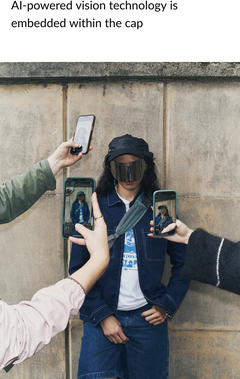
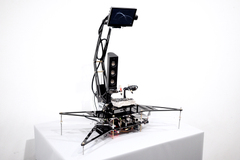
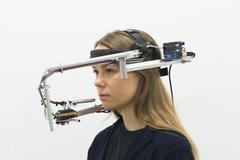
Veil (or Facetook) – a head-mounted system that extracts and repurposes the faces of individuals within camera range. A front-mounted LCD screen will display an animated version of the captured face. Due to the LCD screen, the wearer’s vision will be mediated through a screen (similar to a VR headset).
This project is a direct response to the launch of privacy/identity-annihilating devices from Meta/Facebook (Meta Ray Ban), Google (knock-offs Meta Ray Ban) and Apple (Vision Pro).
In order for art to be meaningful beyond ornamentation/craft, it must provoke an emotional response from the viewer. Seeing one’s own face extracted, co-opted and repurposed – without permission or control – will elicit a strong response AND functions as a powerful material example of surveillance capitalism’s architecture.
Exhibition
Participants will be encouraged to pick up, use the veil and question their relationship with Big Tech. Each object will include context, framing, process and instructions.
Documentary
Report or it didn’t happen – Jeremy Mendel, UX Researcher
As noted in the next section, I will be building a public, digital archive/presence to document my work. Ideally, this can be compiled into a visually rich, long-form thesis document.
Significance
Poets are the Unacknowledged Legislators of the World – Shelley
Our world of 2025 is shaped by Big Tech… for better or, more recently, far worse. Ideas that are extremely critical of Big Tech, presented in the accoutrements of technology can act as a virus of the mind in viewers/users that will force them to ponder the mechanics of Big Tech on themselves and society.
Resources
TBD. I have most of the equipment and materials necessary for completing this work. Mostly, I need feedback and support from staff and fellow grad students! If any items are larger, I may need access to a 4×8 CNC machine but that can, most likely, be outsourced.
Appendix
Process
This is a meaty subject that I’ve spent a decade pondering. Scoping it down into a handful of polished pieces will be tough. I will use a basic design thinking framework to provide structure and guardrails: Understand > Define > Diverge > Decide > Build. This is not a rigid process and some steps can happen in parallel – especially if there are several objects being developed.
- UNDERSTAND/DEFINE – Sept 5 to Oct 15 (40 days)
Articulate the problem from various angles
- Moodboards of tech/devices/artworks
- Review literature cited above
- Develop research diary / notes
- Conduct interviews
- Outline user journeys / personas / archetypes
- Produce research document
- HMW exercise w/ affinity mapping – with willing peers
- Identify and cluster themes/ideas/opportunities
- Identify design principles
- Define success metrics (HEART)
- DIVERGE – Oct 15 to Nov 15 (30 days)
- Crank out 30 different lightweight concepts
- Sketches
- Simple interactive 3D models w/ basic articulation (VR/Unity)
- Collect concepts into a shareable archive
- Crank out 30 different lightweight concepts
- DECIDE – Nov 15 to Dec 1 (14 days)
- Present archive to grad group
- Voting and feedback on concepts
- Focus group / User interviews
- Back of the napkin BOM(s)
- Present archive to grad group
- BUILD – Dec 1 to March 1 (90 days)
- Software/hardware/aesthetics
- Weekly digital updates on personal blog (amplify on, ugh, social media)
- VALIDATE – March 1 to April 1 (30 days)
- QA
- Demos, interviews and feedback
- Present to grads for final feedback
- Revisions and killing of darlings
- PREP – April 1 to May 15 (45 days)
- Tie up any loose ends for exhibition
- Collateral – offline and digital
- Branding
- Design and assemble display
- Promotion
- Tie up any loose ends for exhibition
Literature
Artists and engineers are channeling angst about the psychological damage caused by big tech companies. Here is a short list (needs expansion).
- Oliveira, Pedro & Chen, Xuedi. BACKSLASH toolkit, 2019.
- Selvaggio, Leonardo. URME SURVEILLANCE, 2018.
- Harvey, Adam. CV Dazzle, 2010.
- Harvey, Adam. Stealth Wear, 2013.
- VTOL. Reading My Body, 2013.
- Google, Little Signals, 2022
Bibliography
At the turn of the first quarter of the 21st century, there is no shortage of academics and experts sounding the alarm on what is happening with big technology. This is a short list of works that provide inspiration for this project.
- Benkler, Yochai, et al. Network Propaganda: Manipulation, Disinformation, and Radicalization in American Politics. Oxford University Press, 2018.
- Brayne, Sarah. Predict and Surveil: Data, Discretion, and the Future of Policing. Oxford University Press, 2020.
- Cohen, Julie E. Between Truth and Power: The Legal Constructions of Informational Capitalism. Oxford University Press, 2019.
- Klein, Naomi The Shock Doctrine. Metropolitan Books, 2008.
- O’Neil, Cathy. Weapons of Math Destruction: How Big Data Increases Inequality and Threatens Democracy. Crown, 2016.
- Pasquale, Frank. The Black Box Society: The Secret Algorithms That Control Money and Information. Harvard University Press, 2015.
- Schneier, Bruce. Data and Goliath: The Hidden Battles to Collect Your Data and Control Your World. W. W. Norton & Company, 2015.
- Srnicek, Nick. Platform Capitalism. Polity, 2016.
- Vaidhyanathan, Siva. Antisocial Media: How Facebook Disconnects Us and Undermines Democracy. Oxford University Press, 2018.
- Varoufakis, Yanis. Technofeudalism: What Killed Capitalism. Melville House, 2023.
- Wu, Tim. The Attention Merchants: The Epic Scramble to Get Inside Our Heads. Alfred A. Knopf, 2016.
- Wu, Tim. The Master Switch: The Rise and Fall of Information Empires. Alfred A. Knopf, 2010.
- Zuboff, Shoshana. The Age of Surveillance Capitalism: The Fight for a Human Future at the New Frontier of Power. PublicAffairs, 2019.
The human drivers of Big Tech authoritarianism are also quite opinionated and not shy about sharing their vision for humanity.
- Andreessen, Marc. The Techno-Optimist Manifesto. a16z.com, 2023
- Schmidt, Eric, and Jared Cohen. The New Digital Age: Reshaping the Future of People, Nations and Business. Knopf, 2013.
- Kelly, Kevin. The Inevitable: Understanding the 12 Technological Forces That Will Shape Our Future. Viking, 2016
- Friedman, Thomas L. Thank You for Being Late: An Optimist’s Guide to Thriving in the Age of Accelerations. Farrar, Straus and Giroux, 2016.
- Amodei, Dario. Machines of Loving Grace: How AI Could Transform the World for the Better. darioamodei.com, 2025
- Yarvin, Curtis. Unqualified Reservations (2007–2014). unqualified-reservations.org, 2015
Visual Inspiration







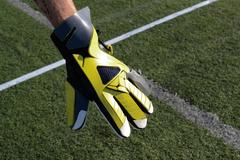
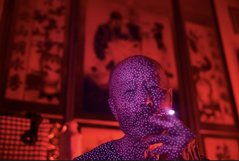


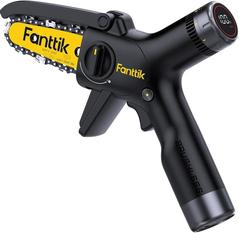  – a head-mounted system that extracts and repurposes the faces of individuals within camera range. A front-mounted LCD screen will display an animated version of the captured face. Due to the LCD screen, the wearer’s vision will be mediated through a screen (similar to a VR headset).
This project is a direct response to the launch of privacy/identity-annihilating devices from Meta/Facebook (Meta Ray Ban), Google (knock-offs Meta Ray Ban) and Apple (Vision Pro).
In order for art to be meaningful beyond ornamentation/craft, it must provoke an emotional response from the viewer. Seeing one’s own face extracted, co-opted and repurposed – without permission or control – will elicit a strong response AND functions as a powerful material example of surveillance capitalism’s architecture.
Exhibition
Participants will be encouraged to pick up, use the veil and question their relationship with Big Tech. Each object will include context, framing, process and instructions.
Documentary
Report or it didn’t happen – Jeremy Mendel, UX Researcher
As noted in the next section, I will be building a public, digital archive/presence to document my work. Ideally, this can be compiled into a visually rich, long-form thesis document.
Significance
Poets are the Unacknowledged Legislators of the World – Shelley
Our world of 2025 is shaped by Big Tech… for better or, more recently, far worse. Ideas that are extremely critical of Big Tech, presented in the accoutrements of technology can act as a virus of the mind in viewers/users that will force them to ponder the mechanics of Big Tech on themselves and society.
Resources
TBD. I have most of the equipment and materials necessary for completing this work. Mostly, I need feedback and support from staff and fellow grad students! If any items are larger, I may need access to a 4×8 CNC machine but that can, most likely, be outsourced.
Appendix
Process
This is a meaty subject that I’ve spent a decade pondering. Scoping it down into a handful of polished pieces will be tough. I will use a basic design thinking framework to provide structure and guardrails: Understand > Define > Diverge > Decide > Build. This is not a rigid process and some steps can happen in parallel – especially if there are several objects being developed.
- UNDERSTAND/DEFINE – Sept 5 to Oct 15 (40 days)
Articulate the problem from various angles
- Moodboards of tech/devices/artworks
- Review literature cited above
- Develop research diary / notes
- Conduct interviews
- Outline user journeys / personas / archetypes
- Produce research document
- HMW exercise w/ affinity mapping – with willing peers
- Identify and cluster themes/ideas/opportunities
- Identify design principles
- Define success metrics (HEART)
- DIVERGE – Oct 15 to Nov 15 (30 days)
- Crank out 30 different lightweight concepts
- Sketches
- Simple interactive 3D models w/ basic articulation (VR/Unity)
- Collect concepts into a shareable archive
- Crank out 30 different lightweight concepts
- DECIDE – Nov 15 to Dec 1 (14 days)
- Present archive to grad group
- Voting and feedback on concepts
- Focus group / User interviews
- Back of the napkin BOM(s)
- Present archive to grad group
- BUILD – Dec 1 to March 1 (90 days)
- Software/hardware/aesthetics
- Weekly digital updates on personal blog (amplify on, ugh, social media)
- VALIDATE – March 1 to April 1 (30 days)
- QA
- Demos, interviews and feedback
- Present to grads for final feedback
- Revisions and killing of darlings
- PREP – April 1 to May 15 (45 days)
- Tie up any loose ends for exhibition
- Collateral – offline and digital
- Branding
- Design and assemble display
- Promotion
- Tie up any loose ends for exhibition
Literature
Artists and engineers are channeling angst about the psychological damage caused by big tech companies. Here is a short list (needs expansion).
- Oliveira, Pedro & Chen, Xuedi. BACKSLASH toolkit, 2019.
- Selvaggio, Leonardo. URME SURVEILLANCE, 2018.
- Harvey, Adam. CV Dazzle, 2010.
- Harvey, Adam. Stealth Wear, 2013.
- VTOL. Reading My Body, 2013.
- Google, Little Signals, 2022
Bibliography
At the turn of the first quarter of the 21st century, there is no shortage of academics and experts sounding the alarm on what is happening with big technology. This is a short list of works that provide inspiration for this project.
- Benkler, Yochai, et al. Network Propaganda: Manipulation, Disinformation, and Radicalization in American Politics. Oxford University Press, 2018.
- Brayne, Sarah. Predict and Surveil: Data, Discretion, and the Future of Policing. Oxford University Press, 2020.
- Cohen, Julie E. Between Truth and Power: The Legal Constructions of Informational Capitalism. Oxford University Press, 2019.
- Klein, Naomi The Shock Doctrine. Metropolitan Books, 2008.
- O’Neil, Cathy. Weapons of Math Destruction: How Big Data Increases Inequality and Threatens Democracy. Crown, 2016.
- Pasquale, Frank. The Black Box Society: The Secret Algorithms That Control Money and Information. Harvard University Press, 2015.
- Schneier, Bruce. Data and Goliath: The Hidden Battles to Collect Your Data and Control Your World. W. W. Norton & Company, 2015.
- Srnicek, Nick. Platform Capitalism. Polity, 2016.
- Vaidhyanathan, Siva. Antisocial Media: How Facebook Disconnects Us and Undermines Democracy. Oxford University Press, 2018.
- Varoufakis, Yanis. Technofeudalism: What Killed Capitalism. Melville House, 2023.
- Wu, Tim. The Attention Merchants: The Epic Scramble to Get Inside Our Heads. Alfred A. Knopf, 2016.
- Wu, Tim. The Master Switch: The Rise and Fall of Information Empires. Alfred A. Knopf, 2010.
- Zuboff, Shoshana. The Age of Surveillance Capitalism: The Fight for a Human Future at the New Frontier of Power. PublicAffairs, 2019.
The human drivers of Big Tech authoritarianism are also quite opinionated and not shy about sharing their vision for humanity.
- Andreessen, Marc. The Techno-Optimist Manifesto. a16z.com, 2023
- Schmidt, Eric, and Jared Cohen. The New Digital Age: Reshaping the Future of People, Nations and Business. Knopf, 2013.
- Kelly, Kevin. The Inevitable: Understanding the 12 Technological Forces That Will Shape Our Future. Viking, 2016
- Friedman, Thomas L. Thank You for Being Late: An Optimist’s Guide to Thriving in the Age of Accelerations. Farrar, Straus and Giroux, 2016.
- Amodei, Dario. Machines of Loving Grace: How AI Could Transform the World for the Better. darioamodei.com, 2025
- Yarvin, Curtis. Unqualified Reservations (2007–2014). unqualified-reservations.org, 2015
V2 Sources (with summary)
Veil (and any other Countermeasures that are developed as part of this thesis) is a multifaceted art-with-a-capital-A project. Surveillance, voyeurism, agency, complacence/compliance, identity, self, performance, legibility, behavioural surplus extraction, capitalism/neoliberalism/fascism, the duality of technology, etc collide in a volatile, confusing thing(s). Below is a short list of sources that provide inspiration, erudition, guidance and philosophical underpinnings for the work.
Platform / State Surveillance
Shoshana Zuboff — The Age of Surveillance Capitalism: AoSC was the inspiration for this project. She has a long history of academic interrogation of the impact of technology on humanity/society. I wish I had read her earlier work In the Age of the Smart Machine: The Future of Work and Power (1989) when I was just starting my career! Fortunately I was able to read AoSC while at Google and it inspired me to leave the advertising side of the business. The primary influence of AoSC on Veil is this concept of identity as a surplus ‘natural’ resource. A resource which tech companies have extracted, refined and packaged to generate enormous wealth, powerful platforms AND vertiginous discord. Chapters 1, 3, 8
Further reading: Julie Cohen – Between Truth and Power: Provides detailed breakdown of the legal and economic functionings of platform capitalism… and how industrial production-based legal/governmental systems which have largely failed to regulate/address them may change their course. Chapter 2, 4, 6
Mark Andrejevic — Automated Media: Interrogate mass automation via current and speculative examples with a focus on academic and philosophical (Foucault, etc) interpretations. Relevant for frame due to the concept of “framelessness” or creating a hyper-aware, duplicated digital reality. Chapters 2.2, 2.4, 4, 6.3+, 7
Frank Pasquale — The Black Box Society: This work focuses on the vexxing core of surveillance: the desire for it to see everything while not being seen. Whether state or capitalism, surveillance thrives in darkness. This helps frame the Veil as a response to enforced legibility (ie recognition) rather than a critique of secrecy. Chapters 1, 2, 4
Masks
Adan C. McGee — Surveillance Countermeasures: The Professional’s Guide to Countering Hostile Surveillance Threats: Collects and updates two seminal tracts on surveillance and countersurveillance: Defeating Hostile Surveillance (2008) and Surveillance Countermeasures (1994). This entire book serves as inspiration for the countermeasures project. Of particular interest for Veil is Appendix 1 wherein the discussion focuses on strengths and weaknesses of technical surveillance (and anti-surveillance).
Hans Belting — Face and Mask: A Double History: Belting believes that the face is a mask (aligns with Goffman’s belief that identity is a theatrical performance). This book explores the face’s history of representation, ritual, and substitution, treating it as something that has always been mediated. His work resists the idea that the face is a stable or purely personal object. For Veil, this history makes it possible to think of facial substitution as continuity rather than rupture AND begs the existential question is Veil the mask or is the original face the real veil? Deep! Chapters 1.1, 1.2, 1.4, 1.6
Andreas Lommel — Masks: Their Meaning and Function: An anthropological survey of masks and their uses in various cultures. Excellent visual reference as well. Frames Veil as a reorganization (or subversion) of social relations, not just a parlor trick or disguise. The other big theme is that the mask defines the ceremony/ritual/situation – it is not merely cosmetic.
Further reading: Gary Edison – Masks and Masking: Faces of Tradition Worldwide
Identity
Wendy Hui Kyong Chun — Control and Freedom: Control and Freedom wrestles with the paradox of technology: oppressor AND liberator. Chun examines how systems of control are often experienced as participation or freedom. This context sharpens the Veil’s engagement with misrecognition, discomfort and agency.
**Further reading: Erving Goffmann – The Presentation of Self in Everyday Life
Facial Recognition
Kelly A. Gates — Our Biometric Future: Probably the most important source for Veil. Gates describes how facial recognition moved from experimental research into routine institutional use… and its impact on society and the individual. Useful for understanding/framing the spectrum of this project (social, personal, policy, technology).
Technology/Reference
- Stan Z. Li, Anil K. Jain, Jiankang Deng – Handbook of Face Recognition: Considered to be “The” handbook on developing technology for facial recognition. Useful for reference or technical understanding.
- **Aditya Gupta – The IoT Hacker’s Handbook
- Milette & Stroud – Professional Android Sensor Programming
- More tbd…
Post-Technology Artist
Sound + Robotics + Kinetic Installations
- Zimoun – builds large-scale kinetic sound installations with simple motors, cardboard boxes, and mechanical repetition.
- Tristan Perich – minimalist works with 1-bit electronics and machine-generated sound.
- Cod.Act (André & Michel Décosterd) – performative sound-sculpture hybrids with robotic instruments.
DIY / Circuit-Bending / Hacking Culture
- Gijs Gieskes – Dutch artist known for modified Game Boys, toys, and circuit-bent machines.
- Reed Ghazala – pioneer of circuit bending as an art practice.
- Nicolas Collins – author of Handmade Electronic Music, works with hacked electronics and DIY audio.
Glitch / Noise / Hybrid Media
- Ryoji Ikeda – though more minimalist, his data-driven audiovisual work shares the sense of technological systems as art.
- Carsten Nicolai (Alva Noto) – works across sound, installation, and visual glitch aesthetics.
- Yasunao Tone – experimental composer using damaged CDs and error-driven sound.
Russian / Post-Soviet Experimental Scene
- Alexei Shulgin – early net.art and software art, often playful like Morozov.
- Staalplaat Soundsystem – international collective with roots in noise art and absurdist sound machines.
- Arseny Zhilyaev – not sound-based, but conceptually similar in techno-futurist critique.
Robotics + Performative Machines
- Norman Tuck – kinetic sculptures and interactive mechanical pieces.
- Arthur Ganson – poetic kinetic machines with absurd and humorous twists.
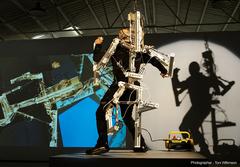
- Chico MacMurtrie / Amorphic Robot Works – robotic sculptures and performance installations.
Inspiration
Links
- https://www.nytimes.com/2025/05/30/technology/trump-palantir-data-americans.html
- https://www.nytimes.com/2025/04/09/us/politics/trump-musk-data-access.html
- https://www.nytimes.com/2024/08/17/style/alex-karp-palantir.html
- https://www.yankodesign.com/2025/09/01/sculptural-surveillance-concept-turns-security-into-art/amp/
- https://www.reddit.com/r/degoogle/
- https://www.reddit.com/r/nextfuckinglevel/comments/1niy5m9/massive_attack_turns_live_facial_recognition_into/
- https://greatorexstreet.com/richardmackness/
- https://hackaday.com/2025/09/18/a-deep-dive-on-creepy-cameras/#more-812163
- https://www.youtube.com/watch?v=Pp9MwZkHiMQ
- https://www.police1.com/police-products/police-technology/publicsafetysoftware/flock-safety-reveals-the-most-expansive-ai-and-data-analysis-toolset-for-law-enforcement-including-flock-nova-a-new-platform-to-transform-investigations
- https://wigle.net/
- https://deflock.me/map#map=12/41.719184/-73.848381
- https://sls.eff.org/technologies/automated-license-plate-readers-alprs
- https://www.nature.com/articles/s41467-025-63373-7
More sources
- 📡 Surveillance, Data, and Control
- David Lyon – Surveillance After Snowden (2015)
- Explores post-Snowden surveillance infrastructures and implications for democracy.
- Virginia Eubanks – Automating Inequality: How High-Tech Tools Profile, Police, and Punish the Poor (2018)
- On algorithmic governance, welfare, and how technology reinforces inequality.
- Ruha Benjamin – Race After Technology: Abolitionist Tools for the New Jim Code (2019)
- Examines how algorithms encode and perpetuate racial bias.
- Simone Browne – Dark Matters: On the Surveillance of Blackness (2015)
- Historicizes surveillance and its entanglement with race.
- David Lyon – Surveillance After Snowden (2015)
- 💻 Platforms, Capitalism, and Political Economy
- Christian Fuchs – Social Media: A Critical Introduction (2017, 2nd ed.)
- Critical theory analysis of social media’s political economy.
- McKenzie Wark – Capital Is Dead: Is This Something Worse? (2019)
- Extends beyond Srnicek and Varoufakis in theorizing new regimes of information capitalism.
- Geert Lovink – Sad by Design: On Platform Nihilism (2019)
- Cultural critique of platform addiction and alienation.
- Cédric Durand – Fictitious Capital: How Finance Is Appropriating Our Future (2017)
- Marxian look at financialization that resonates with Varoufakis’s Technofeudalism.
- Christian Fuchs – Social Media: A Critical Introduction (2017, 2nd ed.)
- 📰 Media, Propaganda, and Attention
- Joan Donovan & Emily Dreyfuss – Meme Wars: The Untold Story of the Online Battles Upending Democracy in America (2022)
- A more contemporary companion to Network Propaganda.
- Kathleen Hall Jamieson – Cyberwar: How Russian Hackers and Trolls Helped Elect a President (2018)
- Case study of disinformation in the 2016 U.S. election.
- Mark Andrejevic – Automated Media (2019)
- Looks at how automation is transforming media systems and propaganda.
- Joseph Turow – The Aisles Have Eyes: How Retailers Track Your Shopping, Strip Your Privacy, and Define Your Power (2017)
- Extension of surveillance/attention into the consumer sphere.
- Joan Donovan & Emily Dreyfuss – Meme Wars: The Untold Story of the Online Battles Upending Democracy in America (2022)
- 🧠 Power, Truth, and Governance
- Tarleton Gillespie – Custodians of the Internet: Platforms, Content Moderation, and the Hidden Decisions That Shape Social Media (2018)
- Connects to Cohen and Vaidhyanathan by examining the infrastructural governance of online speech.
- Wendy Hui Kyong Chun – Control and Freedom: Power and Paranoia in the Age of Fiber Optics (2006)
- A foundational theoretical text tying networks to power and freedom.
- Safiya Umoja Noble – Algorithms of Oppression: How Search Engines Reinforce Racism (2018)
- A critical companion to O’Neil and Pasquale.
- Jack Balkin – The Constitution in the National Surveillance State (2008, article/monograph)
- Legal framing that complements Cohen and Zuboff.
- Tarleton Gillespie – Custodians of the Internet: Platforms, Content Moderation, and the Hidden Decisions That Shape Social Media (2018)
- 🌍 Broader Political Economy of Tech
- Evgeny Morozov – The Net Delusion: The Dark Side of Internet Freedom (2011)
- Early critique of techno-utopianism and state manipulation online.
- Evgeny Morozov – To Save Everything, Click Here: The Folly of Technological Solutionism (2013)
- A broader philosophical-political critique.
- Benjamin Bratton – The Stack: On Software and Sovereignty (2016)
- Dense but ambitious theory of planetary-scale computation and governance.
170a5c151b3bb4c3fd2c7fb8d2bf5d/image.jpg)




































- Dense but ambitious theory of planetary-scale computation and governance.
170a5c151b3bb4c3fd2c7fb8d2bf5d/image.jpg)
- Evgeny Morozov – The Net Delusion: The Dark Side of Internet Freedom (2011)